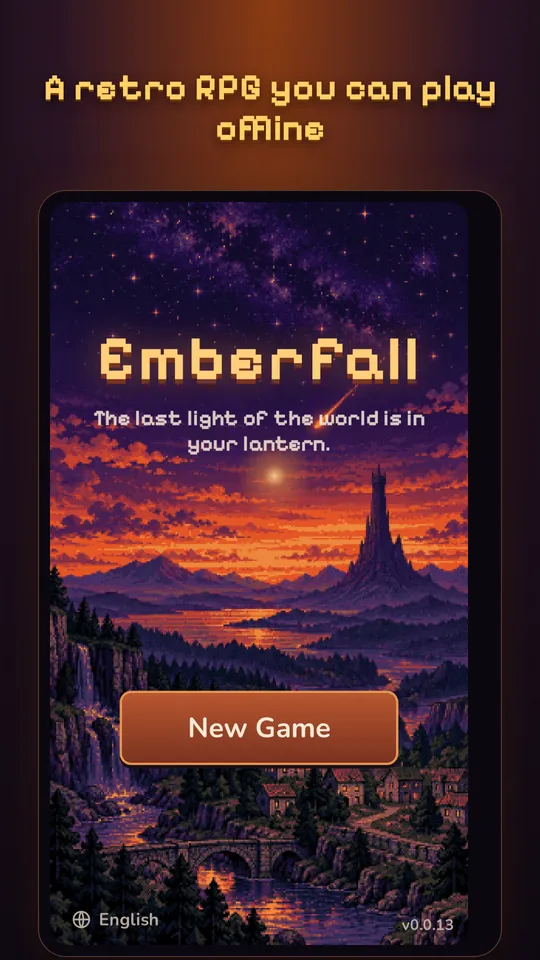
Emberfall: making a retro offline JRPG with a story, five chapters and a 99-cent unlock
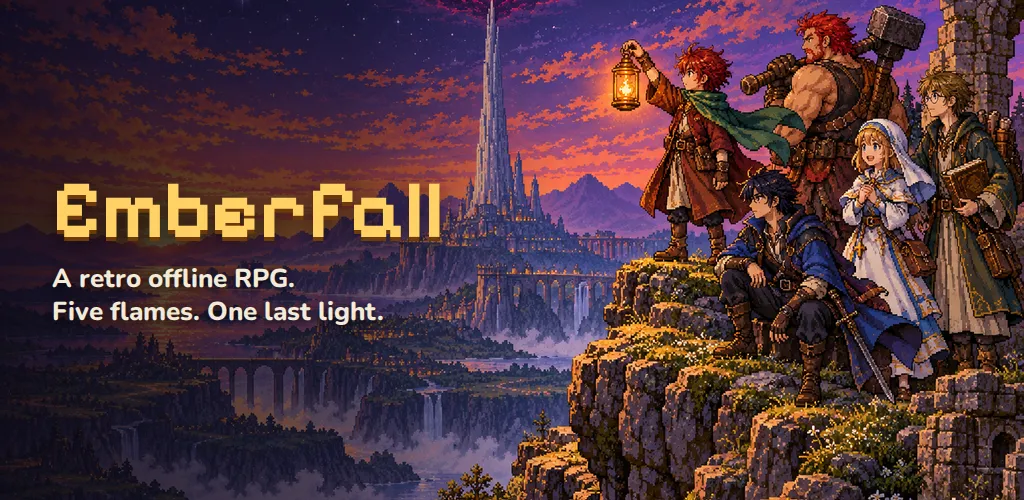
Next on my list of games I'd want to play: something with a story, a world and an ending. I looked at a few options (a hidden-object mystery, tower defence, a puzzle adventure, a survival builder) and chose a retro offline JRPG.
That became Emberfall.
Why a retro JRPG
There's a model for this on Google Play, and it's Kemco: a publisher with dozens of small, cheap, retro-style JRPGs on one engine, sold to 30-to-50-year-old players who grew up with the SNES. It's an older, Western, paying audience, which suits me exactly. "Offline RPG" is a phrase those players actually search for, and the store title leads with it.
A first chapter also caps the cost of a flop. If nobody played Chapter 1, I'd have lost days, not months.
The story
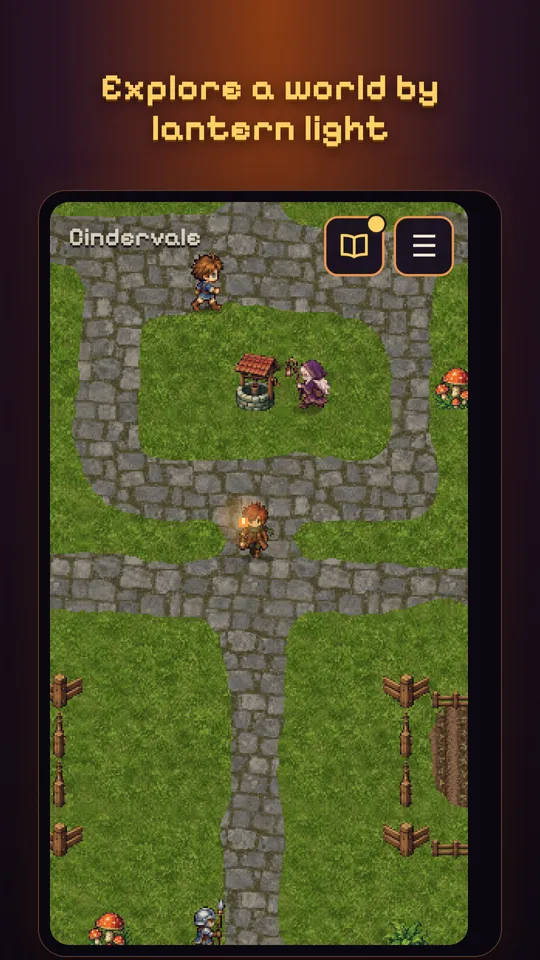
The Great Beacon at the Spire has held back the Dusk for generations: a grey fog in which grief takes shape. Three nights ago it went out. The last ember, a small, dry-witted, rather nervous flame called Lumen, fell into the well at Cindervale.
You play Wren, a lamplighter's apprentice, carrying Lumen in a lantern to the Spire. Along the way you relight five regional flames and gain a companion in each: Bram the fighter, Isolde the smuggler, Sister Ama the healer, and Oren the scholar.
I won't spoil the ending. It's warm and a bit melancholy, never grim, and it is an ending. There's one finale and credits, and the game is done.
Five chapters
- The Forge Flame: Cindervale, the Hollow Woods and the Old Mine.
- The Drowned Light: a salt marsh, a smugglers' cove and a lighthouse, with water, fog and lens puzzles.
- The Candle of Vigil: a frozen stair and a monastery, with sliding-ice puzzles and a bell-order puzzle.
- The Lantern of Lore: a burned library, a push-block puzzle, a Lights Out lamp grid, and the big reveal.
- The Great Beacon: an eight-mirror beam puzzle and the final climb.
It was built as a vertical slice first. Chapter 1 was about 45 minutes, playable in the browser, and I signed it off only after the HD art and music were in. Each later chapter was built while I playtested the previous one.
Battles for people with jobs
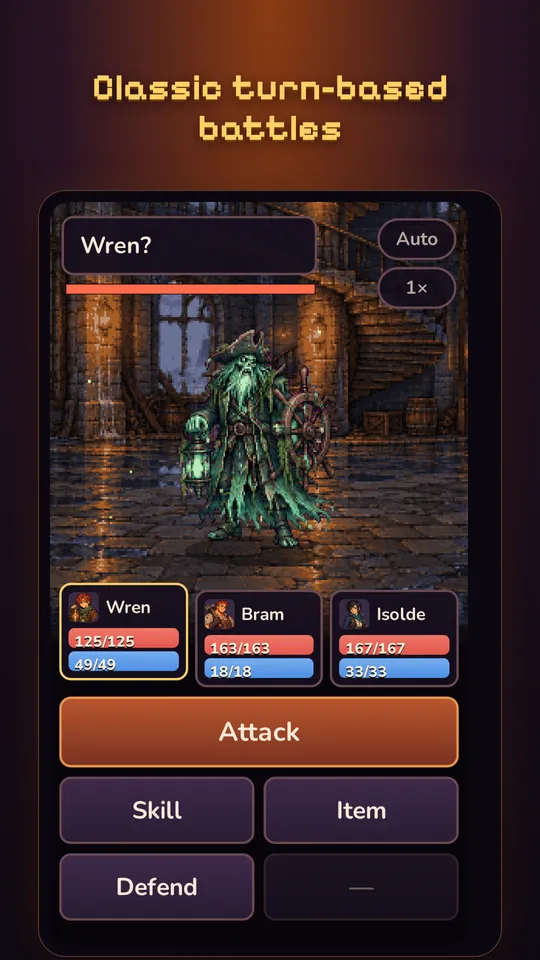
Battles are classic front-view turn-based combat: Attack, Skill, Item, Defend, Run. Two additions matter a lot for the audience:
- an Auto toggle, so a grind fight plays itself,
- 2× speed.
Both are standard in Kemco's games, and both are kind to older players with limited time. Fire is the Dusk's weakness, and learning to spot that is the game's main tactical thread.
The game autosaves on every map change and after every battle, and ember shrines heal and save. Defeat never soft-locks you. An early build's "Retry" replayed an unwinnable fight forever, and "Load save" dropped you deep in a mine at low HP. Defeat now offers "Go home": wake at the inn, healed, with half your gold gone.
Puzzles have to be real
I found the first mirror puzzle (two lenses) and the first ice fields far too easy. Ice puzzles you can solve by walking along the wall aren't puzzles. Now every puzzle is solver-checked:
- ice fields need at least five moves, with exactly one shortest route and an easy way back,
- the library push puzzle needs 18 pushes, the lamp grid 6 presses, the Spire push puzzle 24,
- the mirror puzzles have exactly one route. One was verified by brute force over all 4,096 mirror facings.
Two rules came from getting stuck myself:
- After a boss, nothing waits on an unprompted tap. I walked past the crates holding Chapter 2's lamp oil twice. Now a companion opens them in a cutscene, or tells you exactly where to go.
- A story trigger must catch every route. One trigger was a single row of tiles, and you could walk round it, leaving a door shut forever.
A journal, opened by a book button by the menu, now always says what to do next.
Pricing: $0.99, or two videos
Chapter 1 is free. At the end of each chapter you choose: a one-time US$0.99 unlock for the whole game, or watch two rewarded videos to open the next chapter. And if ads fail to load, you're never locked out.
It's deliberately cheap. The goal is to see whether a story game converts at all at an impulse price. If it does, a second campaign on the same engine could sell for US$1.99. If it doesn't, the two-videos route still pays something for every chapter played.
It went to closed testing first and production soon after. Next week: the technical side, including a phone that ran Chapter 2 at 11 frames per second.