Tavern Heroes: building an offline idle RPG, and abandoning a painted town after three attempts
After the Sovereign ads test I changed what I build: no paid installs, and games I'd actually want to play, in genres where players find new games by themselves. Idle RPGs are top of that list. Tavern Heroes is the first, and the game I most wanted to play myself. It's an idle RPG in the spirit of Soda Dungeon: you don't fight battles, you run a tavern full of heroes. Hire them, gear them up and send them on missions, then come back to the loot.
The positioning is simple: offline, fair, no gacha. The idle RPG genre on mobile is dominated by gacha games with energy timers and summon banners. There's room for one that respects older players' time and wallets.
The loop
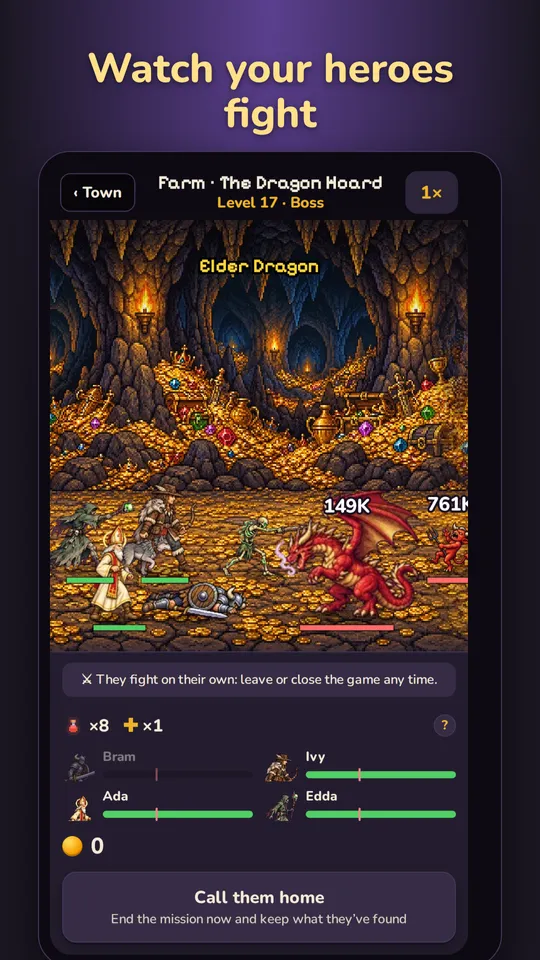
- Short missions (30 seconds to 10 minutes), watched live: Skirmish, Farm, Expedition and Endless Dive, where your party goes as deep as it can until it wipes.
- Long missions (2 to 12 hours) that run offline: Patrol, Campaign and Boss Campaign. Before you send a party you see its odds ("Success: 78%"). When you return, the final fight replays from a saved seed, so you see what actually happened. You can call a party home early for a share of the gold and XP.
- Orders you set once: stance, potion threshold, when to retreat. Playing without playing.
- A roster of heroes who level up and are busy while on long missions. That's what makes hiring more of them worth it.
Gear has three slots, and rarity is simply item level (Common to Unique is +0 to +30 levels). Spare items can be fused into a rarer one or melted into ore for the Blacksmith.
Prestige: retire for Renown
Once you've beaten Level 5's boss, you can retire: give up your depth, gold, gear and hero levels in exchange for Renown, which boosts everything permanently. You keep your heroes, their training, trophies and achievements.
Two lessons came out of real play here:
- Buildings now survive retirement. At first they didn't, and retiring threw away days of upgrades. It felt like punishment, not progress.
- Training survives too. The Training Yard gives each hero +10% to every stat per level, with time gates that grow (1 minute, 5 minutes, 30 minutes, 2 hours, then +6 hours per level). Throwing that away on retirement would have made the long waits pointless.
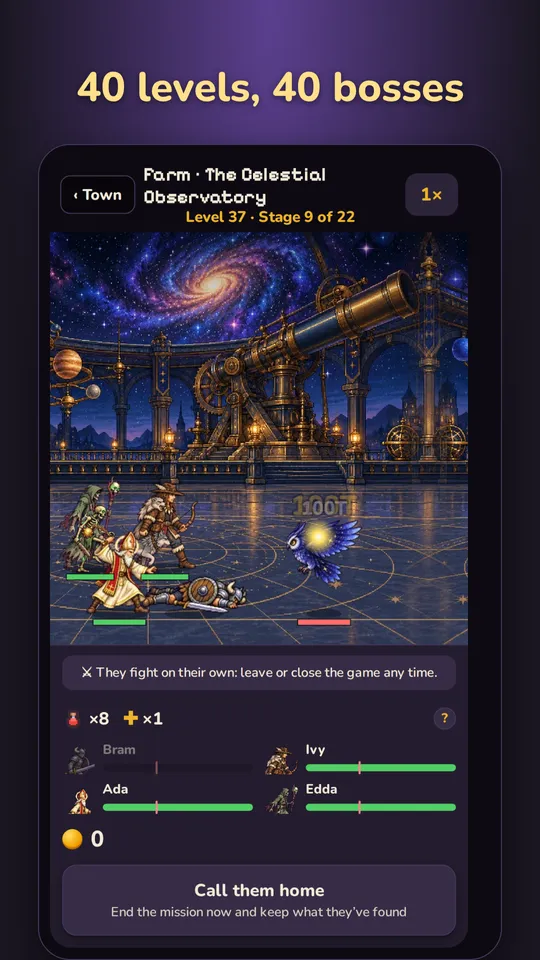
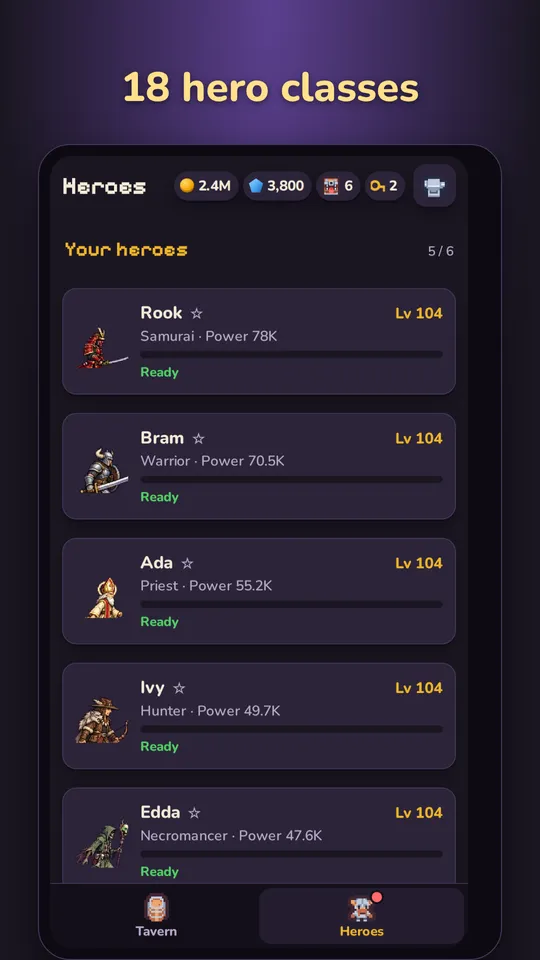
There are 40 levels, each with its own name, backdrop and boss, and 18 classes across six roles: fighter, protector, healer, caster, marksman and skirmisher. You start with three, and each early boss unlocks another.
The simulator came before the art
I built a headless simulator before drawing a single hero, with three bot players: a lazy one, a sensible one, and one who only ever sends long missions. The targets: first wipe-out within about five minutes, no wall needing more than about three attempts, and a daily player reaching floor 50 in about a week, while a long-missions-only player still progresses.
Real play then found what the bots couldn't:
- A Blacksmith exploit. Upgrade prices came from the item you were wearing, so a level-1 vest could be upgraded cheaply and the upgrade moved onto real gear. Upgrades now live on the slot, priced from your deepest stage.
- Ore was a dead currency. I retired with 30,000 ore unspent, because gold costs compounded and ore costs didn't. When a cost has two currencies, compare how fast each cost grows with how fast that currency comes in.
- Numbers overflowed. Around Level 340 stats passed 1.8×10³⁰⁸ and became
Infinity, which saves asnull. Gold, ore, XP and stats are now big-number Decimals. Use them from the start for anything exponential.
Three attempts at a painted town
The original plan was a town you could walk around: a tavern, a training yard, a smithy, each a painted place with heroes moving around in it.
I tried it three ways: sprites on a painting, a set built from sprites, and finally a painted town map with painted heroes. None of them reached a look I was happy with. My own verdict on the third attempt was that the graphics were beyond what I could produce for interactive scenes at this budget, and that the game should be menu-only.
So it is. Tabs for Tavern (home), Heroes, Missions, Gear and Town. Battles keep their sprite scenes, because watching a fight is the payoff. Everything else is calm menus.
In hindsight it was the right call for the genre. The best idle RPGs (Melvor Idle is the obvious example) are mostly menus done well. The rules I took from it:
- one main action per page,
- rewards you can collect go first on the home screen,
- red dots only where there's actually something to do.
Onboarding: play first
A new player's first launch opens on a fight, not a menu. The innkeeper unlocks things one at a time. Two things went wrong:
- The first lesson ("they don't need you") sent new players to an empty Tavern with nothing to do. The Tavern now shows the party's live progress.
- I'd played for 40+ hours before I noticed that "How to play" was only reachable from Settings. It now opens once, after the opening fight.
Money: rewarded videos only
No banners, no interstitials. Rewarded videos give bonus chests, 2× XP, 2× speed or double loot. No Ads (a one-time purchase) claims every bonus with a tap. There are ore packs for people who want them. Things that would feel pay-to-win (revives, skipping time) exist in the code but are switched off.