Diggings: a gold-rush game where you pan the creek before you swing the pick
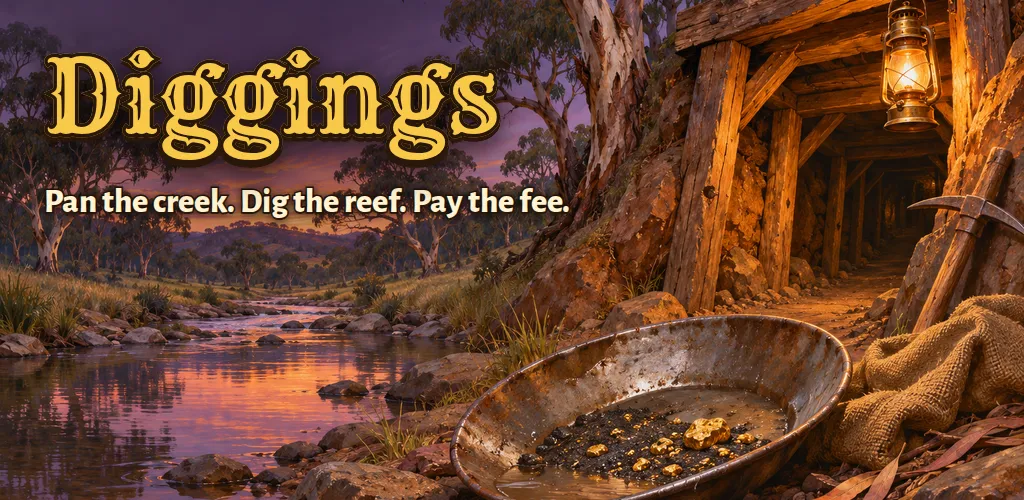
Diggings is out on Google Play. It's a gold-rush game set on the 1850s Australian goldfields. You have a tin pan, a claim at Forest Creek and a warden who wants his fee every five days. Hold the claim until winter and you've won the season. Miss a payment and it's forfeit.
The shape I wanted: a bill on a deadline, short runs, something permanent carried over from each one, and the real chance of losing. I wanted a game where losing a season is part of the point, not a pause before the next idle upgrade.
Why a gold rush
Partly it's the setting. The Victorian goldfields are on my doorstep, and the place names in the game (Forest Creek, Reedy Creek, the Ovens River, Sandhurst Reef) are real ones.
Partly it's what people type into Google Play. When I searched the store on 5 November, "gold mining" had a top app with 176 million installs, and "gold rush" a median of 200 thousand installs in the top ten, with four of those ten under 100 thousand. None of the top ten for "gold rush" had the words in its title. There was room for a young game with a clear name.
Panning comes first
I built the rock face first. Then I added panning and made it come first, because it's what a prospector would actually do on day one.
A season starts at the creek:
- Scoop gravel where the water slows. Gold drops on the inside of bends and just below boulders, with black sand lying alongside it, so reading the creek is the skill before the pan is.
- Flick the stones out of the pan.
- Wash it with a well-timed tap. A dark streak of black sand and gold rides round the pan. Tap with the streak on your side and the wash comes out clean. Tap with it at the lip and some of your gold spills over.
That's the whole first lesson, with one finger and no menus.
Then the pick
Win a season at the creek and work 10 metres upstream, and the hill opens. At the rock face you split chunks along their cracks, follow the quartz reef into the hill, and fire the face with dynamite when it's cleared. Dynamite only moves the face. It pays nothing, and the gold still in the rock when it goes is lost, so the sensible order is to dig out the reef first.
There are nine places on two tracks: three creeks to pan and six places on the hill to dig. Each is richer and harder than the last, and you can push either track first.
A day and a season
A season is 20 days, in four periods of five. The claim fee falls due on the evening of every fifth day and climbs each time. A day is a budget of 30 washes or swings to start with, and it ends on its own when they run out.
Then comes the evening, one step at a time:
- The assayer weighs your gold, pays you for the day and takes the fee if it's due.
- Some nights bring an event with a choice to make: the creek's up, a dent in your pan, a platypus at dusk.
- You spend the day's cash on the skill tree (61 skills for the pan and 61 for the pick), then sleep.
The skills reset every season, so you can try a different approach. What stays is your savings, which buy better pans and picks (eight levels each), equipment such as a tent, boots and scales, and licences for new claims. There are 27 finds to dig up for a trophy cabinet: a brass button, a worn penny, a belt buckle, and so on.
A season is about twenty minutes, a natural place to stop. It's also short enough to try again at once when you lose.
What it doesn't do
There are no banners and no pop-up ads. Videos are always optional, a bonus you can take or leave. A one-off purchase, the Miner's Right, gives you every video reward without watching one. It works offline and it's in 12 languages.
I'll go into the decisions behind it in later posts: why there's no energy timer, and how I found out the first balance was wrong.