Designing 75 ball skills for a brick breaker roguelite
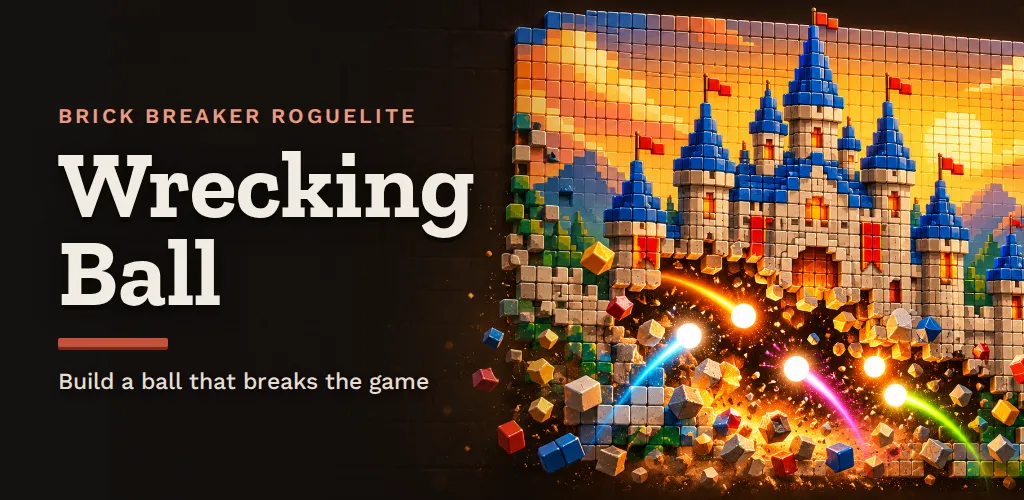
A roguelite lives or dies on its build choices. In Wrecking Ball the choices are ball skills: every ball you fire carries the skill of the slot it came from. I wanted enough skills that no two runs feel alike, and every one of them good for something. The launch has 75.
Start with research, not imagination
Before writing a single skill, I studied the two games that do this best: Idle Brick Breaker and The Tower, both by Tech Tree Games. Their fan wikis list every ball type, card and upgrade, with exact numbers. That gave me a map of what's been done, what players love (poison and splash are "required to get anywhere" in Idle Brick Breaker), and what doesn't translate.
Some things didn't fit. The Tower is about enemies that advance on you, and Wrecking Ball's boards don't move, so every skill built around approaching enemies was left out. About a third of the final list comes from those two games, adapted. The rest are new, many built around something those games don't have: boards that are pictures.
Five families
The 75 skills fall into five families, so a build has real choices rather than 75 flavours of "more damage":
- Damage and shape (24). Explosive, Split, Heavy, Chain lightning, Demolition, Prism (hitting steel splits the ball into beams), Twin, Swarm.
- Effects the ball leaves on bricks (14). Burning, Frozen, Poison, Acid (cuts a brick's maximum health), Colour Link (hits every brick of the same colour in the picture), Heartseeker (the picture's gold bricks and eyes).
- Movement and tricks (21). Boomerang, Saw (grinds along brick edges), Orbit, Leader (the next balls follow its exact path), Copycat (copies the skill in the slot before it).
- Gambles (10). Glass (×3 damage, shatters after three hits), Demon (×6 damage, but lost for the level if it lands without breaking anything), Black Hole (crushes bricks, and swallows your own balls if it catches them). The downside is always written in plain words on a red-edged card.
- Economy and support (6). Quarry (more stone, no extra damage), Flare (shows your aim line further), Relay (triggers the next slot's skill).
Ten are free at the start, the rest are unlocked in the workshop, priced from "about two runs" to "about a week".
Every skill has three twists
Skills level from 1 to 10 in the workshop, and levels 3, 6 and 10 each add a twist, not just bigger numbers. Explosive's blasts get a bigger radius at 3, hit twice at 6, and chain at 10. Homing gets stronger, then targets the weakest brick, then steers through walls. Levelling a skill should change how you play it, not only how hard it hits.
Balancing 75 skills against each other
With 75 skills, "balance by feel" isn't possible. Each skill has a power factor, fitted by a tool that runs each skill alone across many boards and compares it with a plain ball. The targets:
- every ball skill is worth about 2.5 plain balls at level 1 and about 8 at level 10,
- gambles are tuned a bit stronger (×1.3), because they carry real risk,
- support skills a bit weaker (×0.75), because their value shows up in other balls' numbers.
Change a skill, re-run the fit. The numbers come from the simulation, never from a guess.
Three things that broke
- Fractional hits counted as full hits. Every hit dealt at least 1 damage, so effects that deal 10% or 30% (a lightning link, a comet's graze) were secretly full-strength hits. The floor is now 0.01, and several "weak" skills turned out to have been strong only because of it.
- Percentage-of-health skills ignored depth. Poison, Volatile and Proportional dealt a share of a brick's maximum health, so they did the same job at level 200 as at level 2, whatever the difficulty curve said. Each is now capped relative to the ball's own damage.
- Some skills had nothing to do. Sword, Quake, Prism and Saw all work on steel bricks, and picture boards had almost none. Now about 3% of each picture's side and top edge bricks are steel (never the underside, never two side by side), so those skills always have something to bite on.
A build is an average, not a product
One finding changed the whole balance. A volley goes round-robin through your slots: ball 1 from slot 1, ball 2 from slot 2, and so on. So a full build is worth roughly the average of its skills, not their product, and stacking more slots raises your floor rather than multiplying your ceiling. That's what keeps deep runs finite, and why the really big numbers come from somewhere else: the Forge, which gets its own post.