Bible Word Search: a themed fork in two hours, Bible translation licensing, and curating 30,000 verses
The first fork of the Word Search engine was Bible Word Search. Faith-themed word games are a strong niche in the US, the audience matches the engine's (older, American, daily players), and the change from the parent is mostly content. The first version took about two hours, store listing and all.
Most of the interesting work came afterwards.
Licensing: why not the NIV
My first instinct was the NIV, the most widely read modern English translation. It needs a commercial licence for use in an app, so it was out. The first build used the King James Version, which is public domain but archaic, and English quality matters most because the US is the main market.
I settled on the Berean Standard Bible, a modern English translation that is in the public domain. For the other languages I use older public-domain translations: Reina-Valera 1909 (Spanish), Bíblia Livre (Portuguese, CC BY), Louis Segond 1910 (French), Elberfelder 1905 (German) and Riveduta 1927 (Italian). They're old-fashioned, but they're free to use, and I'll revisit them only if reviews complain about archaic language.
The general lesson: check the licence on your content before you build on it. Text, word lists, fonts, music, all of it.
Levels made of verses
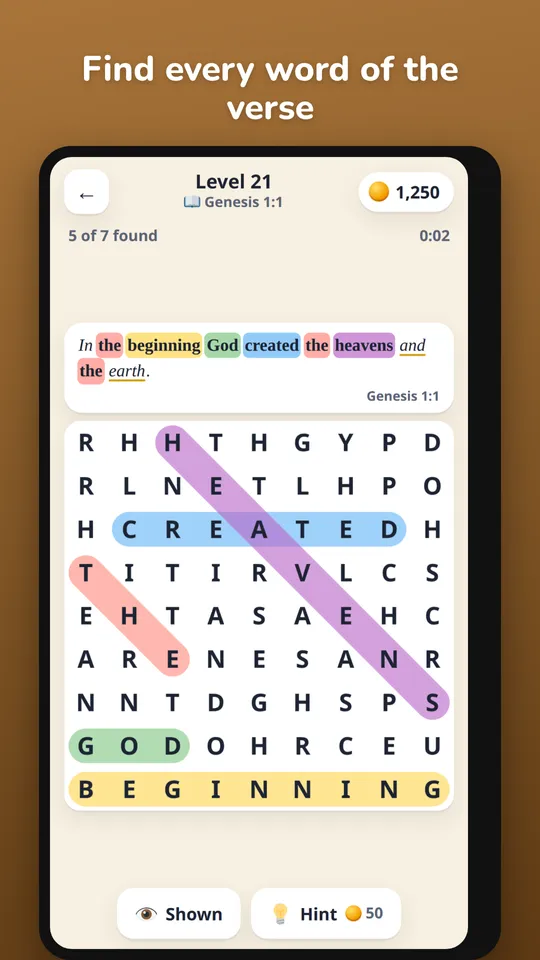
The first version reused the engine's themed word lists, with 42 Bible themes per language. It was fine. Then I changed what a level is: each Journey level is one Bible verse, and you find every word in it.
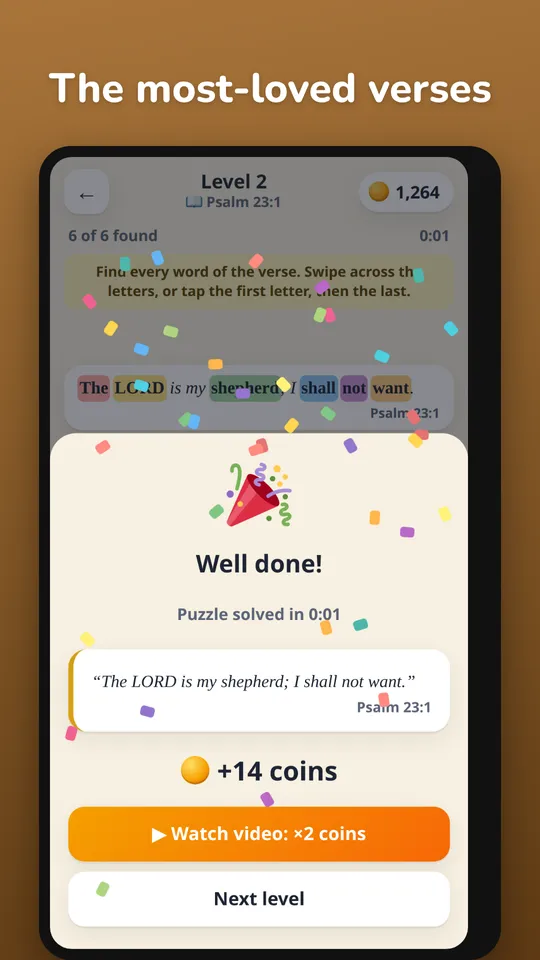
- There are 22,800 levels per language, most-loved verses first, using topical popularity data from OpenBible.info.
- Grids size themselves to the verse. Verses too long for a 12×12 grid split into parts at the ends of clauses.
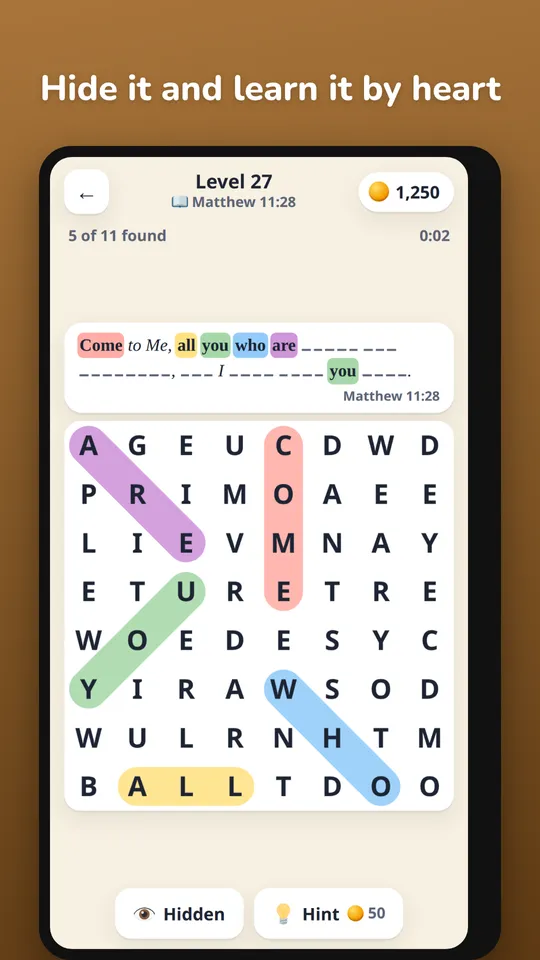
- Verse words can be always shown, hidden progressively, or always hidden. New players choose before level 1, because most players never open Settings.
One thing surprised me: popular verses are long. The median verse has 15 findable words, and John 3:16 has 23. Word count, not word length, is what limits the grid size.
Testing this means generating a lot of puzzles. The test suite builds the first 3,000 levels in every language (36,000 puzzles, each under 11 ms) and checks every one.
Whole Bible mode
While playing it myself I kept wanting to just pick a verse, any verse. So now you can: choose a book, chapter and verse, or search for "john 3:16". Every verse you solve, in any mode, is ticked off, and the game shows how much of each book, each chapter and the whole Bible you've completed. That's about 31,000 verses in English.
Every one of those verses has to build a valid puzzle, so the test plans about 250,000 puzzles across six languages with zero failures. German and Italian spell numbers out in words, and some of those words run past 30 letters. A Whole Bible mode can't grow the grid for them, so words over 15 letters are filled in for you.
The daily puzzle became the Verse of the Day, drawn from the 1,500 most-loved verses.
Curation: popularity isn't a good first impression
Ordering levels by popularity alone put "Wives, submit to your husbands" (Ephesians 5:22) at level 3. I hit it in my own playtest within minutes. It's a popular verse because people look it up, often to argue about it, and it's not what you want a new player to meet in their first two minutes.
Some verses are now held back until level 200 or later, and the Song of Songs is mostly left out of the Journey. The lesson generalises: search popularity measures what people look up, not what makes a good first impression. Anything ordered by popularity needs a human to read the first fifty items.
Content rating: the Bible isn't rated like a Bible app
Reading apps get a 3+ rating because they're "all other app types". A game that shows text is rated on that text as game content. Answer the IARC questions honestly about every verse in the Bible and you get an R18+ in Australia and a refusal in Taiwan.
So the game leaves out about 64 reviewed verses describing sexual violence, and answers "sexual references without detail" and "alcohol, referred to, rarely" for the rest. The result is Google Play 12+, PEGI 12 and ESRB Teen. That's an honest rating for the content, and still reachable for the audience.
Blocking ad categories
For a faith audience, one bad ad costs more in one-star reviews than blocking costs in revenue. In AdMob, this app alone blocks dating, get-rich-quick, references to sex, sensationalism, sexual and reproductive health, and social casino games (alcohol and gambling are blocked by default). Religion, politics, weight loss and supplements stay allowed. Christian advertisers fit this audience, and blocking everything starves the auction.
A false alarm
One morning Firebase sent a "Revenue spiked" alert for Bible Word Search. It was my own test purchase. RevenueCat forwards sandbox purchases into analytics marked environment=SANDBOX. Check that field before celebrating.