Word Slide and Word Push: inventing a word puzzle, and the playtest that said it was far too hard
Everything in the portfolio so far had been chosen by search volume. Word Slide wasn't. It's the one I wanted to make for myself.
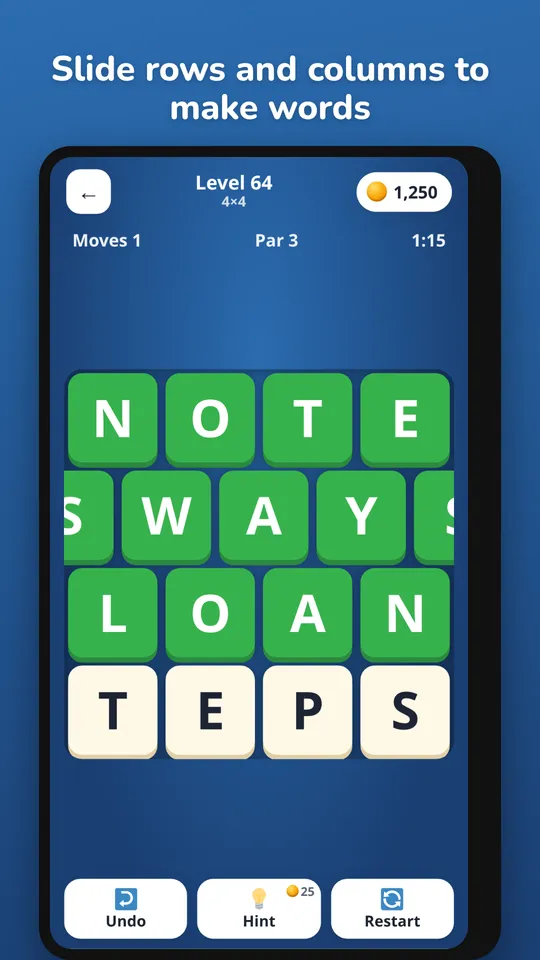
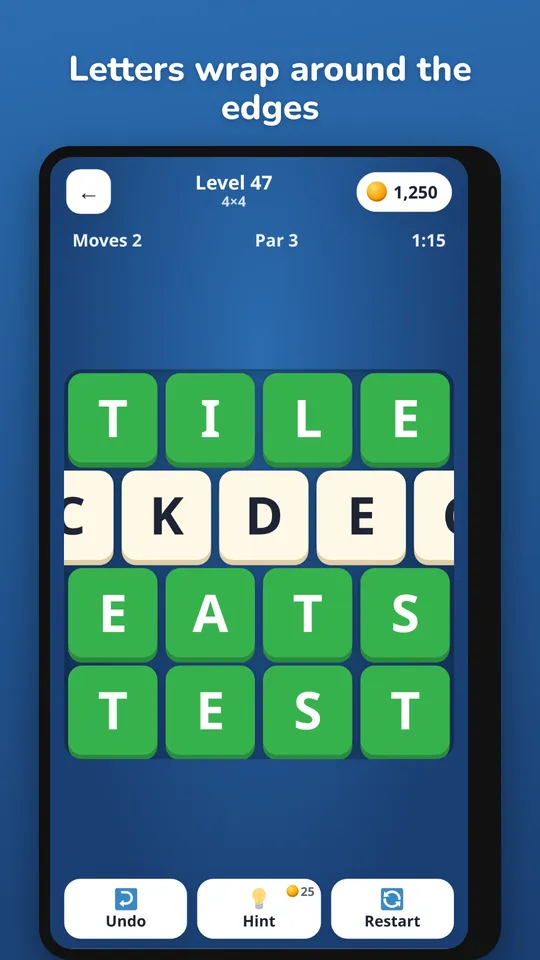
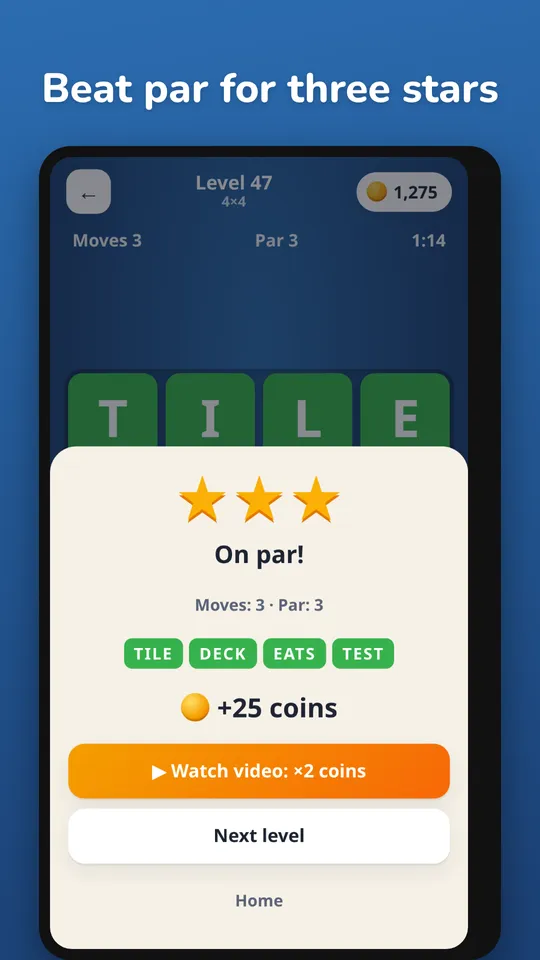
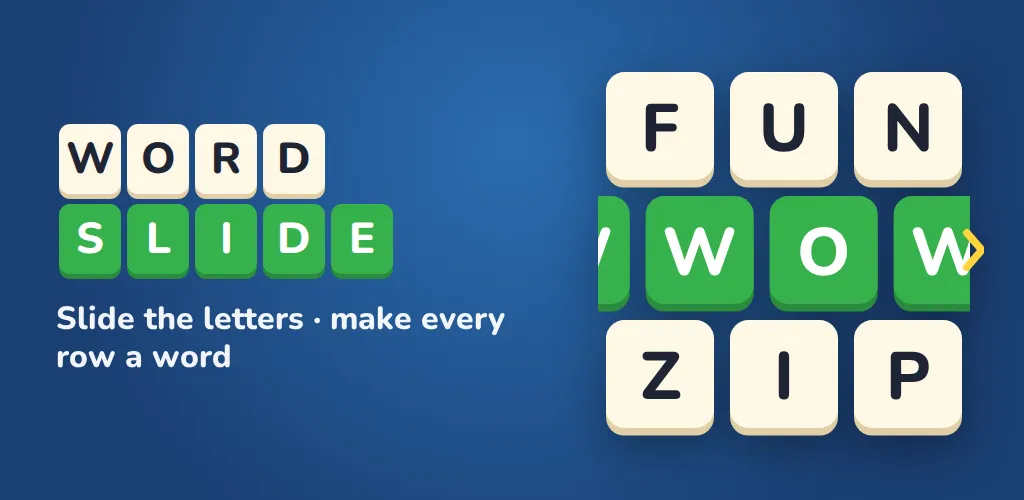
The idea is Loopover's mechanic with letters. You have an n×n grid of letter tiles. Slide a whole row or column one step, and the tile pushed off one edge wraps around to the other. A row turns green when it spells a word. Solve every row within par for three stars.
Its sibling, Word Push, keeps one spare letter in a pocket under the board. You push the spare into any row or column from either end, and the tile that falls off the far end becomes your new spare. Nothing wraps.
Content is generated, not written
Hand-making thousands of these puzzles isn't possible, and a puzzle with a wrong par is worse than no puzzle. So the levels are built by a solver:
- Every move has an inverse (slide left undoes slide right), so the space of board states is an undirected graph, and plain breadth-first search gives exact distances.
- The generator scrambles solved boards and uses a meet-in-the-middle search to find each puzzle's exact par.
- 2,000 levels from 3×3 to 5×5, plus 1,200 daily puzzles, build in about four minutes.
- The dictionary has two lists: answers (common words puzzles are built from, and hints steer towards) and accepted (every word that counts if a player happens to make it).
The English word list comes from SCOWL. When I added eleven more languages later, each got its own frequency-ranked list (FrequencyWords, built from subtitles, CC BY-SA). The candidate words were filtered down to roughly half per language, because subtitle data is full of names and English loanwords. Letters a language treats as its own (Ä, Ö, Ü, Ñ, Æ, Ø, Å, Polish letters) are tiles. Other accents fold away, the way each language's Scrabble does it. The test suite checks every puzzle in every language: about 154,000 checks for Word Slide alone.
The playtest: "far too hard to learn"
The solver said every level was valid and every par exact. Then I sat down to play it properly and couldn't solve level 2, a one-move puzzle, except by luck.
The reason was obvious once I saw it. You only see letters. There's no hint about which words you're aiming for, so every move is a blind guess. The solver knew the answer and I didn't. A solver's exact par says nothing about whether a human can see the move.
The fixes:
- Show the target words under the board. Levels 1–10 show all of them. Then they hide in steps, and a hint reveals one.
- Levels 1 and 2 show their single move with an arrow.
- A much gentler curve: 3×3 until level 25, 4×4 at par 2 until level 40, harder pars only after 80.
- A found word stays shown, even through Restart.
I also decided against a "swap two tiles" tool. A swap flips the board's parity, so a wrong swap can take the planned solution permanently out of reach. Instead, after 20 slides without solving, a tip points at Restart: "the start is only N moves from solved."
That tip shipped with a bug. It appeared in the page flow and pushed the board down mid-puzzle, right under your finger. It now floats above the board, and a flow test asserts the board doesn't move when the tip appears.
Word Push: the variant that turned out just as hard
Word Push was supposed to be the easier one, because you choose where the spare goes. Playing it, it isn't. The freedom of choosing is offset by each push changing a line's letters, not just their order. It's about as hard as Word Slide and, to my surprise, quite fun.
Technically it was nearly free. The engine had supported a "push" rule from the start, with tests but no UI, so the whole game was a new interface and a regenerated level bank (two minutes of solver time).
Naming a new mechanic
A new mechanic has no search volume. Nobody searches for a game they've never heard of. So the store listings lead with the phrases people do type ("word puzzle game", "brain teaser"), and the names have to be findable by people who heard about them elsewhere.
"Word Slide" turned out to be shared by 10 to 50 other games, none of which play like mine. It ranks around 4th or 5th for its own name. "Word Push" was unique, and it ranks #1 for its own name. For a game whose installs will come from word of mouth and links from my other games, that's what matters. If you're inventing a mechanic, pick a name nobody else has.
Translation
Word Slide shipped in English first. Generated levels make other languages cheap: a new language needs only a word list, and the solver builds its puzzles. So it was always going to be translated, and later it was. That story, and the sale that followed it, is in the post about my first purchases.