Sovereign: building a polished no-guess Queens puzzle, and launching it with a paid ads test
After parking my idle game, I wanted to do one game the other way: properly. Polished, finished, every detail considered. Sovereign is out today on Google Play.
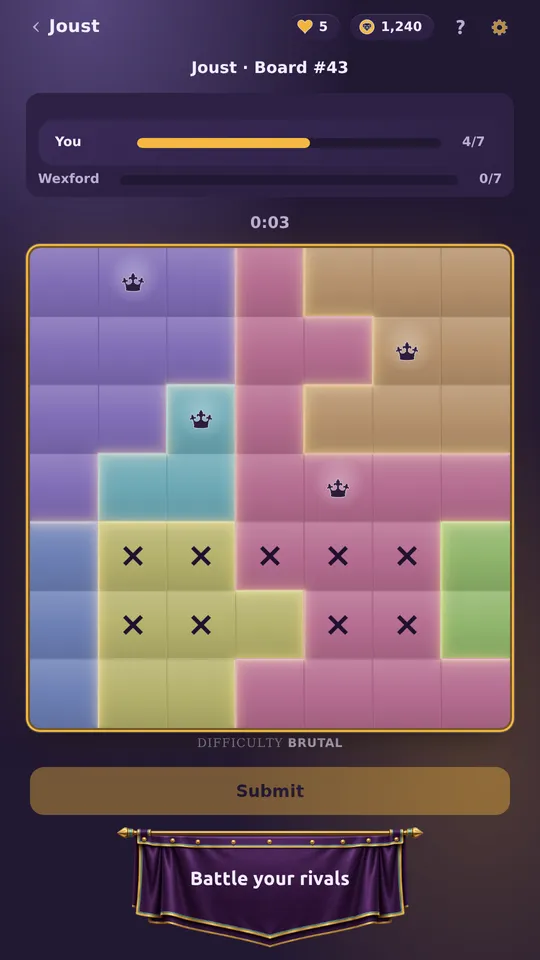
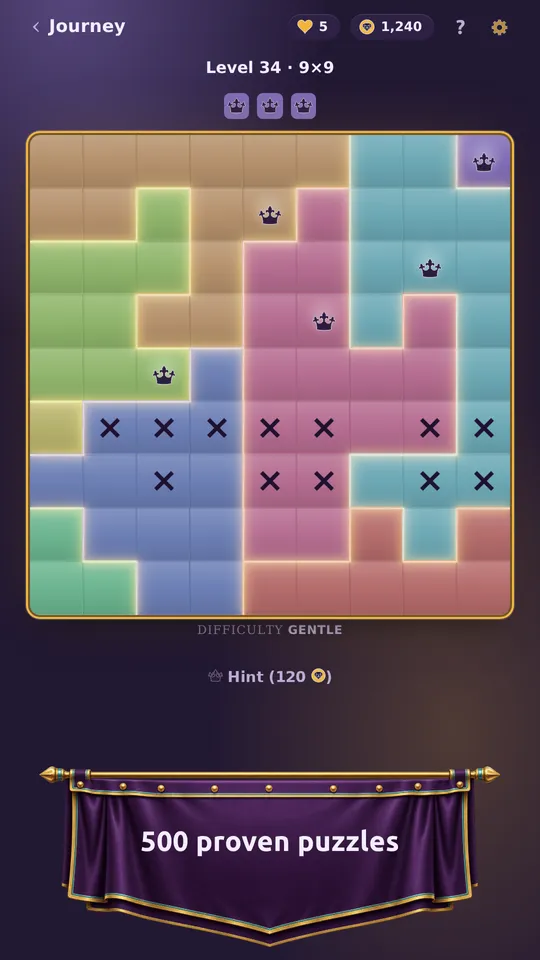
It's a logic puzzle. Place one queen in every row, every column and every coloured territory, and no two queens may touch, not even diagonally. If you've played the Queens puzzle on LinkedIn, it's that idea built out into a full game.
The promise: you never have to guess
Every board you can lose a life on has been proven to have exactly one solution and to be solvable by deduction alone. That's what makes charging a life for a wrong queen fair. If a board needed a guess, losing a life on it would be the game's fault, not yours.
The generator works like this:
- Pick the solution first. A random valid placement of queens.
- Grow the territories out from the queens, with a seeded flood fill. Every board therefore has a solution by construction.
- Prove it's unique. A solver counts solutions, stopping at two. If there's an alternative, the board isn't thrown away, it's repaired: take a cell from the alternative solution and hand it to a neighbouring territory, keeping everything connected. Pure rejection sampling accepts about 0.1% of 8×8 boards. With repair, almost all of them.
- Play it like a person. A deduction ladder tries human techniques in order, cheapest first: forced cells, locks, squeezes, sets, and finally trial and error. A board that needs trial and error needs a guess, so it's dropped from the campaign. That's about 2% of 6×6 boards and 8% of 9×9 ones.
Generation is fully deterministic, so the daily board is the same for everyone in the world, and difficulty comes from which rungs of the ladder a board needs, not from how long a computer took to solve it.
Six modes
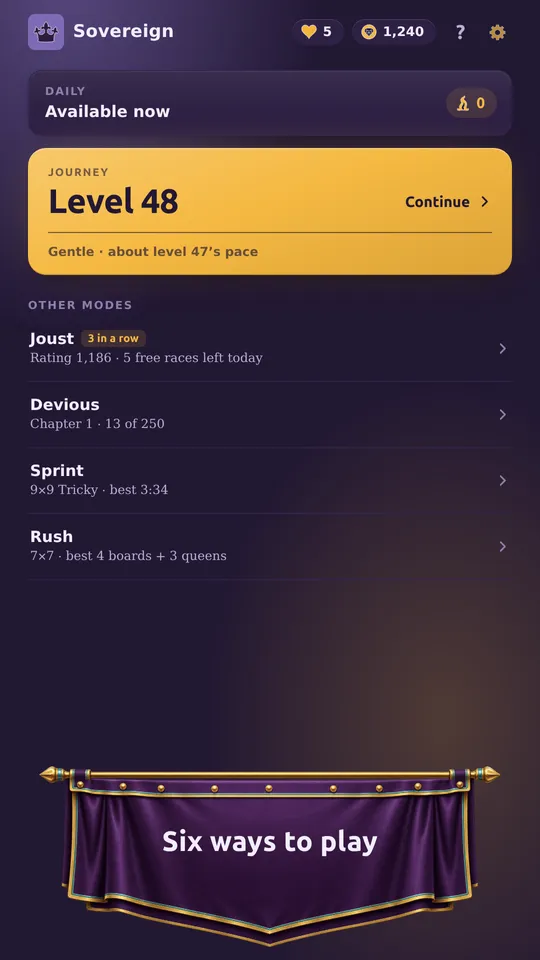
- Journey: 500 designed boards from 4×4 to 9×9, with a curve that spikes every seventh level and follows each spike with relief. After that, the journey never ends: later boards are generated on the device from their level number, so level 700 is the same board on every phone.
- Daily: one board a day, the same worldwide.
- Joust: asynchronous races. Every solve records a small replay, and a race pits you against another player's replay on the same board, shown as a race bar. The replay never shows where they put their queens, or it would give away the answer.
- Devious: 250 large boards where the deduction ladder runs out on purpose. Hard boards on small grids turned out not to be devious at all: when you can see the whole board at a glance, guessing and retracting takes seconds.
- Sprint and Rush: against the clock, one life.
The ladder and the races run on a Cloudflare Worker with a SQLite database. There are no accounts, so every rule that matters (who won, what a rating is worth) is checked on the server, never trusted from the phone.
Small details I care about
- A tap marks a cell; a double-tap places a queen. A cheap, reversible mark and a life-costing queen should never be one gesture apart.
- Nothing on the board reacts to correctness until you finish. A board that glowed when you were right would be a free answer key.
- A gutter keeps the board clear of Android's back-gesture strip. Before that, sweeping marks down the outer column could close the game.
- 21 languages, each with its own store listing.
The launch is an experiment
Here's the part that's different from my earlier games. I'm launching Sovereign with a paid Google Ads campaign, a bit over A$200, as a deliberate test. My word and card games rely on people finding them in search, and that's slow. I want to know, with real numbers, whether paying for installs can work for a small game.
The ads are set up the way I wanted them: interstitials only after every few finished boards, none in the first ten levels, never after a failure, and one rewarded video for an extra life. Polite, and, I hope, still profitable.
I'll report back with the numbers in a couple of weeks, whichever way they go.