Genesis: designing an idle game about the evolution of life
After a run of word and card games, I wanted something people play for weeks, not minutes. Idle games (incremental games, clickers) are the obvious candidate: long lifetimes, players who come back several times a day, and natural places for rewarded ads.
Genesis is an idle game about the origin of life. You start with a single replicator in a primordial soup and end with a mind that spans the world. It's the biggest thing I've built so far, so it gets a few posts. This one covers the design.
The core loop: a producer cascade
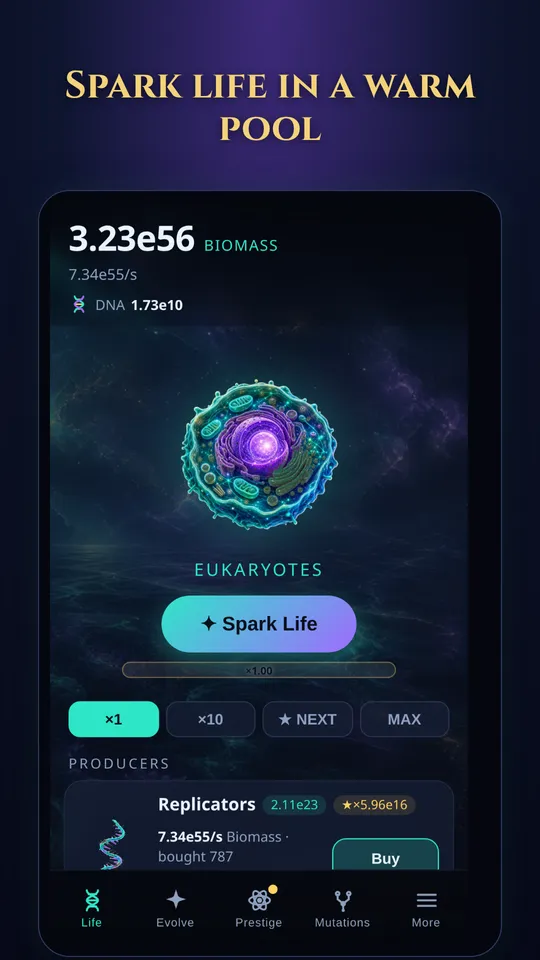
There are eight tiers of life: Replicators, Prokaryotes and on up to Biospheres. Each tier produces the tier below it, and tier 1 produces Biomass, the currency. Early on you tap "Spark Life" to get going, buy a few producers, and the cascade starts feeding itself.
Every ten manual purchases of a producer doubles its output. That's a classic incremental rhythm: a visible target, a satisfying jump, and a reason to keep buying the tier that feels weakest.
Prestige: Extinction and the DNA strand
Every idle game needs a reset that makes you stronger. In Genesis it's Extinction: wipe the run, keep DNA.
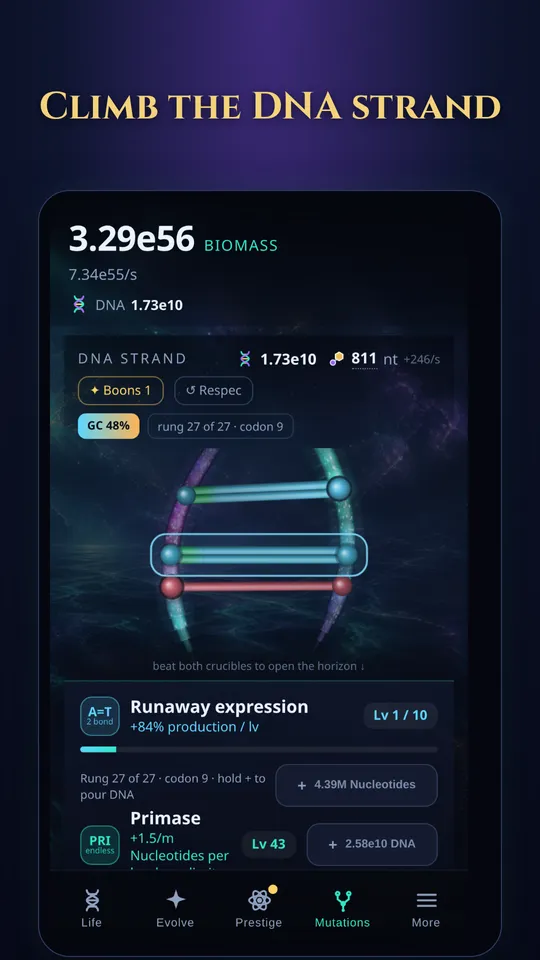
DNA is spent going down a double helix of 27 rungs. At each rung you commit to a base pair: A–T is cheap and weak, G–C is costly and strong, and the choice is locked once made. Every three rungs form a codon with a capstone bonus. It turns "spend prestige currency on upgrades" into something you can see: a strand of your own design, growing downwards.
Every nine rungs sits a Challenge Gate. To go deeper you must beat a crucible, a run under a hard rule.
Crucibles are designed to be failed first
I spent more time on crucibles than on anything else, and one decision shaped them: failing a crucible costs nothing. Entering one snapshots your whole game. Win, fail or quit, you're restored exactly. Only the reward leaves the sandbox.
I considered two alternatives and rejected both:
- Live challenge runs (the Antimatter Dimensions style), where your economy carries in. That ties the difficulty of a challenge to how strong you happen to be, so it's either trivial or a wall.
- Fail means a dead run. That punishes you for trying, so players wait until they're massively over-levelled, which defeats the purpose.
The UI shows your best attempt, so a failure reads as "not yet" rather than "no". Targets freeze the first time you see them. The game's scaling grows the targets by 1.6× per Extinction, and it would be miserable to chase a wall that moves. The line I kept in the design doc: the wall does not move, you do.
A gate's reward is always a mechanic, never a percentage: your strand survives an epoch, or every tenth purchase is free. "+15% production" is invisible after five minutes. A new rule changes how you play.
Four commitments
Early on I wrote four rules for the game, and most of the design follows from them:
- Idle is a fully functional baseline. You don't have to tap.
- Time away is never punished. Offline progress is exact (more on how in a later post).
- Rewards are mechanics, not percentages.
- No paid shortcuts through challenges. No purchase and no watched ad makes a crucible easier. Remove Ads gives a permanent speed boost, and inside a crucible it's switched off.
Chapters
The game is split into chapters, each with one structure and one dimension:
- Chapter 1, Genesis: the strand, 1D, with Extinction as the prestige.
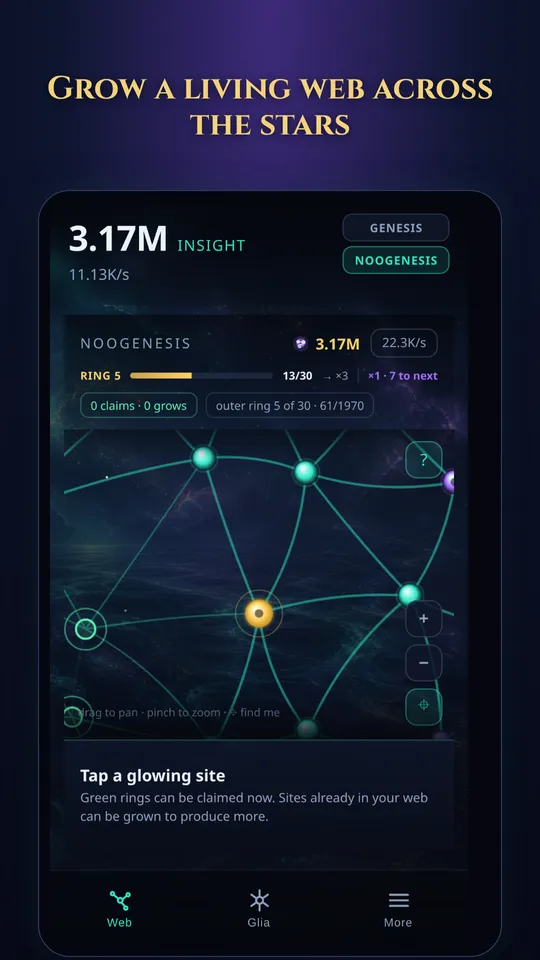
- Chapter 2, Noogenesis: a 2D hex web. You claim sites and grow minds in them. There's no reset here. It's deliberately a long climb.
- Chapter 3, Panspermia (planned): a 3D shell of 80 facets around a sphere, with its own reset, Collapse, which pays Stardust.
Nothing carries across a chapter boundary except one fixed amount of starting currency. An earlier design let a bonus multiplier carry over, and it quietly broke the next chapter's balance. Isolation is now enforced in the code, so it can't creep back in as a default argument.
What I cut
An earlier version had a third prestige layer, Ascension, with a cosmic garden. Once I re-pointed the balance at real players (a 40–70 day arc, measured, not guessed), Ascension arrived on about day 40, with almost nothing left to do. It was cut, and its two best ideas are archived for later. Two optional crucibles went the same way.
Cutting is harder in an idle game than anywhere else, because everything feeds everything. The rule that helped: if a layer arrives after most players have stopped, it doesn't exist.
Like most idle games, it has no ending. There's always another layer to add and another curve to tune, and I suspect that's going to be a problem. Next: the maths of offline progress, then the simulator that lied to me for a month.